
We are excited to share our most recent publication “Integrating computational fluid dynamics and artificial intelligence for predicting in-flight thermo-kinetic properties in cold spray” in the Journal of Manufacturing Processes, in collaboration with the Surface Engineering Institute (IOT) at RWTH Aachen university.
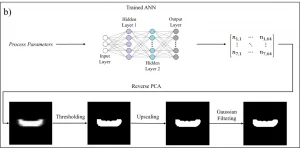
In this study, a computational fluid dynamic (CFD) model was developed to simulate the cold spraying process. The simulations were repeated on a wide range of process parameters and on different substrate geometries, and the generated data was used to train an artificial intelligence (AI) model of Support Vector Regression (SVR) with the objective of directly predicting the thermo-kinetic properties of the metallic powders. To strengthen the interpretability of the prediction model, the explainable AI method of SHapley Additive exPlanations (SHAP) was implemented to identify how each input parameter affects the model predictions for particle temperatures and velocities. The combined CFD-AI approach showed high accuracy and efficiency in predicting the thermo-kinetic conditions of the powder while maintaining the physical interpretability of the related phenomena. This integrated method enables advanced optimization strategies for controlling the Cold Spray process.