We are excited to share our latest publication, titled “Extending artificial-intelligence-assisted single bead geometry prediction to multi-bead interaction in fused granulate fabrication” in Progress in Additive Manufacturing.
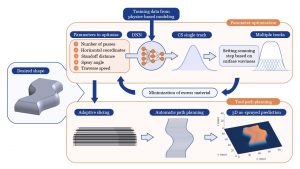
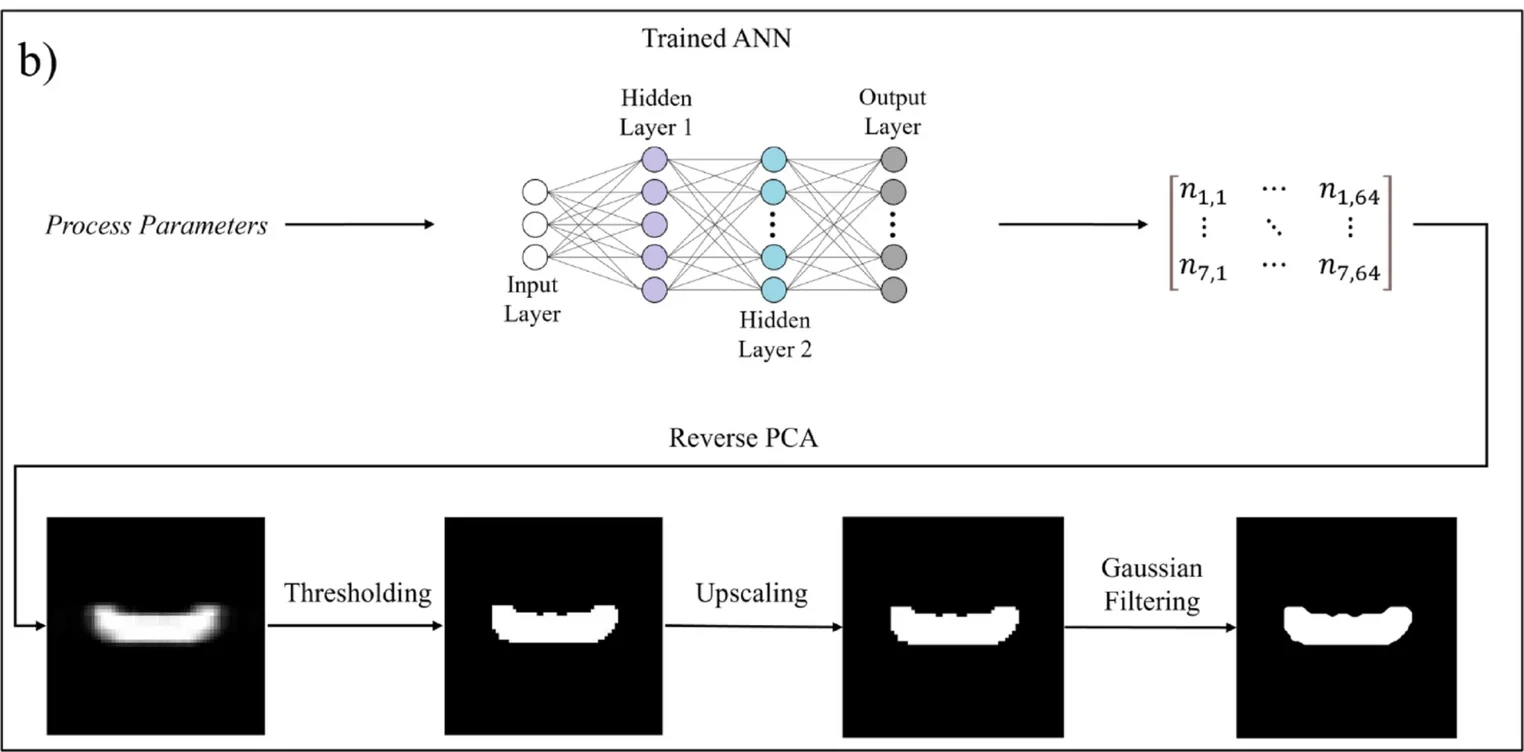
Accurate prediction of the cross-sectional geometry of deposited beads is essential for improving process control in Fused Granulate Fabrication (FGF), a key process within the Large Format Additive Manufacturing (LFAM) family. Building upon the previous model for single bed shape prediction, this work addresses the complex problem of reconstructing the full cross-sectional shape of polymer beads in multi-bead configurations, focusing on both adjacent and superimposed beads, through an Artificial Neural Network (ANN). A structured dataset was generated by varying critical process parameters, namely layer height, screw speed, and bead center distance. The ANN, designed with two hidden layers and supported by image processing techniques, successfully captured the geometric features of the deposited material, reaching a mean absolute error of 10.22% across all tested conditions. Unlike traditional methods that approximate only a limited number of contour points, the approach proposed here, enables full-profile prediction, offering a deeper understanding of bead interactions and the dynamics of layer formation. The findings represent a significant step forward aimed at improving the geometric accuracy and the process control in LFAM applications, contributing to a better understanding of the role of the key process parameters.