
What happens when 2D materials meet cold spray additive manufacturing?
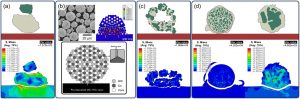
One of the biggest challenges in advanced materials engineering is translating the exceptional properties of 2D materials such as graphene into scalable 3D components without compromising their functionality. Traditional high-temperature manufacturing routes often limit this potential. In our latest work within the ThermoDust project, we demonstrate how Cold Spray Additive Manufacturing can be leveraged to produce graphene-reinforced copper composites, opening new possibilities for integrating 2D materials into industrial-scale applications.
Our findings reveal how processing conditions, microstructural evolution, and interfacial bonding collectively govern the final performance of these novel composites. More importantly, the study highlights both the opportunities and challenges of integrating graphene into metal matrices, showing that the path from promising nanomaterials to real-world engineering applications depends on carefully controlling material architecture across multiple length scales.
This work was made possible through the collaboration between Politecnico di Milano, University of Twente, Trinity College Dublin and Universitat de Barcelona, bringing together expertise in additive manufacturing and advanced materials.