What really happens at the atomic scale when a cold-sprayed particle impacts a substrate at supersonic velocity?
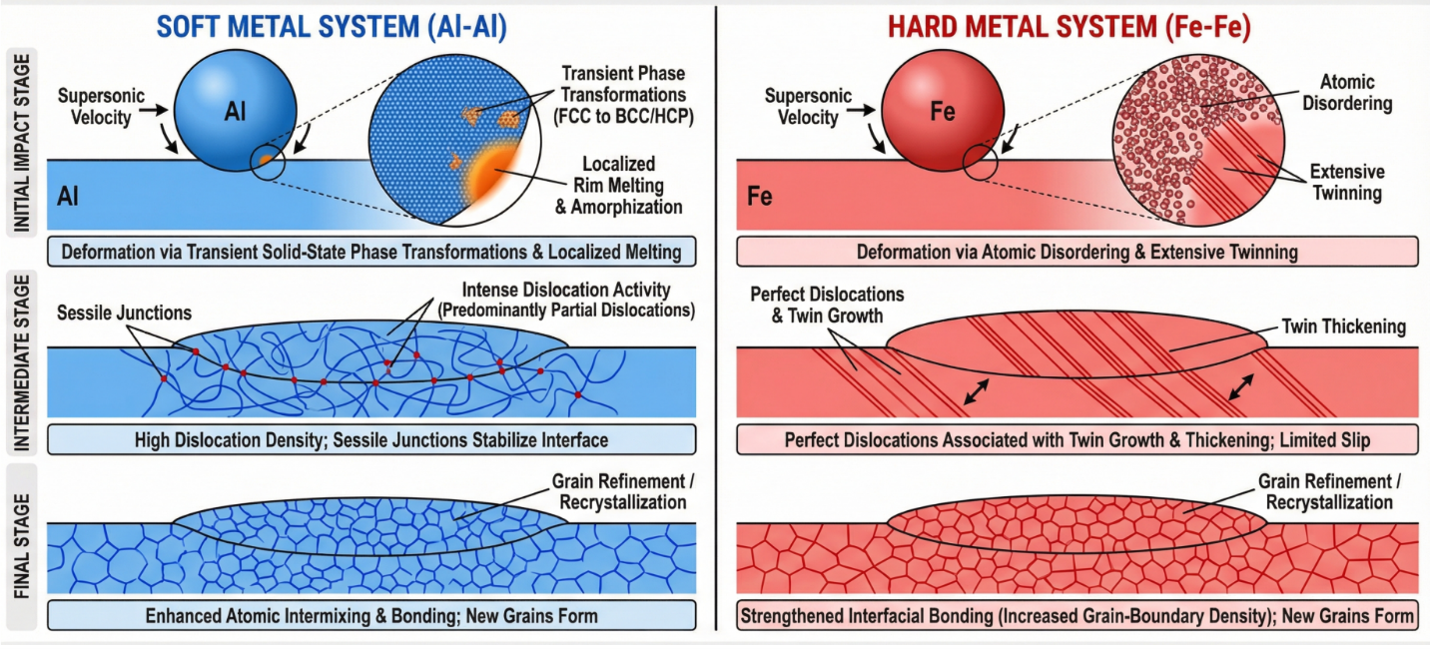
Answering this question requires looking far beyond conventional observations. In our latest research, we employed advanced large-scale molecular dynamics simulations involving millions of atoms to uncover the fundamental mechanisms governing interfacial bonding in Cold Spray.
The study combines a wide range of atomistic, metallurgical, and materials science analyses, including defect evolution, dislocation dynamics, stacking faults, deformation twinning, phase transformations, localized melting and amorphization, atomic mixing, stress and strain evolution, grain refinement, recrystallization, and crystallographic characterization. By systematically comparing FCC and BCC metallic systems, we reveal how crystal structure dictates deformation mechanisms and ultimately controls the quality of metallurgical bonding under extreme strain-rate conditions.
Beyond providing a detailed atomic-scale picture of particle impact, this work offers new insights into the physical origins of solid-state bonding and contributes to a deeper understanding of Cold Spray from a fundamental materials science perspective.